As Western Ranchers Face Water Shortages, Should Industrial Bug Farms Compete for Scarce Resources?
Across the American Southwest, water is becoming the most important limiting factor in agriculture. Ranchers, farmers, and rural communities are already adapting to persistent drought conditions, declining snowpack, and changing weather trends that are putting increasing pressure on limited water supplies. At the same time, policymakers and investors are promoting industrial insect farming as a new agricultural sector—often proposing facilities in the same water-stressed regions. This raises a basic question: should emerging experimental protein industries be competing for scarce Southwestern water resources when existing food producers are already under pressure?
2/20/20263 min read
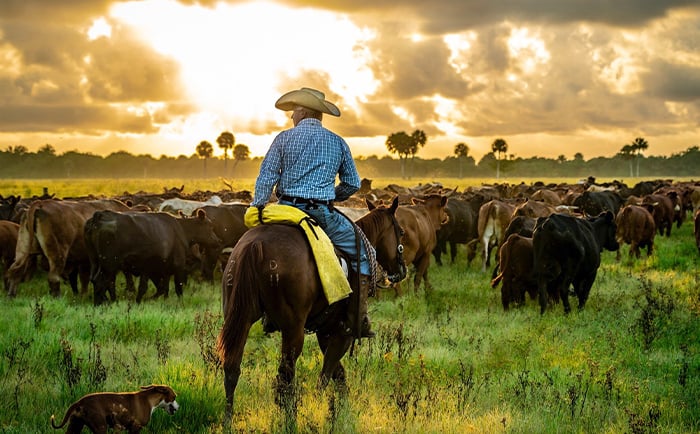
Across the American Southwest, water is becoming the most important limiting factor in agriculture. Ranchers, farmers, and rural communities are already adapting to persistent drought conditions, declining snowpack, and changing weather trends that are putting increasing pressure on limited water supplies.
At the same time, policymakers and investors are promoting industrial insect farming as a new agricultural sector—often proposing facilities in the same water-stressed regions.
This raises a basic question: should emerging experimental protein industries be competing for scarce Southwestern water resources when existing food producers are already under pressure?
Water scarcity is already threatening Southwestern agriculture
The American West is experiencing a long-term water crisis driven by prolonged drought cycles, reduced snowpack, and changing precipitation patterns. The Colorado River system alone supports tens of millions of people and millions of acres of farmland, yet its water supplies are under severe strain.
Recent data shows:
• Much of the western United States regularly experiences drought conditions
• The Colorado River Basin has faced sustained water shortages
• Water constraints are forcing difficult allocation decisions between agriculture, cities, and industry
Farmers and ranchers are already being asked to conserve water, fallow land, reduce herd sizes, or change production practices in response to shortages.
This is not a hypothetical future problem. It is happening now.
Agriculture already faces intense water competition
Agriculture remains the largest water user in the Southwest, largely because irrigation is necessary in an arid climate. In some regions, irrigation accounts for the vast majority of total water consumption.
At the same time:
• Groundwater reserves are being depleted faster than they recharge
• Reservoir levels remain under pressure
• Long-term weather variability is increasing uncertainty for farmers
This means every new industrial agricultural project—whether traditional or novel—must be evaluated in terms of long-term resource competition.
Industrial insect farming is not impact-free
Insect protein is often marketed as environmentally lightweight, but real-world industrial production involves resource tradeoffs that are often overlooked in marketing discussions.
Industrial insect facilities typically require:
• Climate-controlled indoor production environments
• Temperature and humidity regulation systems
• Processing infrastructure
• Water for sanitation, processing, and maintaining feed substrates
In many cases, these facilities must maintain narrow temperature ranges year-round, which increases infrastructure demands and operational complexity.
Environmental outcomes therefore depend heavily on how these facilities actually operate—not just theoretical efficiency comparisons.
Location matters when evaluating sustainability claims
Even if a production method is efficient per unit of protein, placing new industrial agriculture in water-stressed regions can still increase regional resource pressure.
The key question is not just:
Is this production method efficient?
But also:
Is this the right place to expand new industrial agriculture?
In a region where water allocation disputes already exist between states, cities, and farmers, adding new industrial demand—of any kind—raises legitimate policy questions.
Policy priorities matter in times of scarcity
Water scarcity forces prioritization.
Should scarce water resources go toward:
• Maintaining existing food production systems
• Supporting rural agricultural communities
• Experimental food technologies still seeking market viability
Reasonable people may disagree. But the question deserves open discussion rather than assumptions that all alternative protein development is automatically beneficial.
Supporting resilience in existing agriculture may offer clearer returns
Traditional ranching and farming are already deeply embedded in regional economies and food supply chains. Investments in:
• Water efficiency improvements
• Drought resilience
• Soil health
• Grazing management
• Irrigation modernization
may offer clearer and more immediate returns than subsidizing new experimental sectors competing for the same scarce resources.
This is not an argument against innovation. It is an argument for prioritization when resources are limited.
The real issue is resource stewardship
The debate is not beef versus bugs.
It is whether limited natural resources should be allocated based on proven food production value, economic stability, and regional sustainability rather than speculative projections.
Water scarcity is forcing difficult decisions across the Southwest.
Those decisions should be guided by:
Real resource constraints
Real economic performance
Real food system needs
Not marketing narratives.
The bottom line
Western agriculture is already adapting to a future defined by water scarcity. Ranchers are reducing herds. Farmers are fallowing land. Communities are negotiating over every acre-foot.
In this environment, policymakers should carefully evaluate whether subsidizing or promoting new industrial agricultural sectors—of any kind—represents the best use of scarce water resources.
Water policy is food policy.
And in the American West, every drop matters.
Beef Not Bugs is a campaign focused on protecting American agriculture, supporting ranchers and farmers, and ensuring a safe and reliable food system.
We work to raise awareness about the risks of industrial insect farming and advocate for policies that prioritize traditional agriculture and rural communities.
© 2026. All rights reserved.